← All insights
MedTech

When Does the EU AI Act Apply to Medical Devices?

UBIQ Events
·
October 23, 2026
When Does the EU AI Act Apply to Medical Devices?

Key takeaway

AI medical devices that need a notified body become high-risk under the EU AI Act from 2 August 2028, and the 2026 Digital Omnibus kept them fully in scope. What changes on top of the MDR, and how to prepare.

Short answer: From 2 August 2028 for most AI medical devices. Under the AI Act, an AI system that is a medical device, or a safety component of one, is high-risk when the device needs a notified body under the MDR or IVDR. That covers Class IIa, IIb and III devices and most IVDs. The Digital Omnibus, in force since July 2026, moved this deadline from August 2027 but kept medical devices fully in scope. Manufacturers will need one technical file that meets both the MDR and the AI Act.

Key takeaways

  • The Digital Omnibus on AI, Regulation (EU) 2026/1744, delayed high-risk obligations for medical devices and other regulated products from 2 August 2027 to 2 August 2028. It was published in the Official Journal on 24 July 2026 (Cuatrecasas).
  • Stand-alone high-risk AI listed in Annex III now applies from 2 December 2027, instead of 2 August 2026 (Gibson Dunn).
  • The Commission had proposed taking medical devices out of the AI Act's full high-risk regime, but Parliament and Council rejected that in May 2026, so devices stay fully in scope (Gleiss Lutz).
  • An AI medical device is high-risk when it needs third-party conformity assessment by a notified body, so most Class I devices are out and Class IIa and above are in (MDCG 2025-6, via Hogan Lovells).
  • The MDCG recommends a single set of technical documentation and one conformity assessment covering both the MDR or IVDR and the AI Act.

Which AI medical devices count as high-risk?

The test is in Article 6(1) of the AI Act. Two conditions must both apply: the AI system is a medical device, or a safety component of one, and the device needs third-party conformity assessment by a notified body under the MDR or IVDR.

  • High-risk: MDR Class IIa, IIb and III devices; Class I devices that are sterile, have a measuring function or are reusable surgical instruments; IVDR Class B, C and D, and sterile Class A.
  • Not high-risk under this route: non-sterile, non-measuring Class I devices and non-sterile IVDR Class A, which manufacturers self-certify.

Being high-risk under the AI Act does not raise a device's MDR class. It adds requirements on top.

What did the Digital Omnibus change?

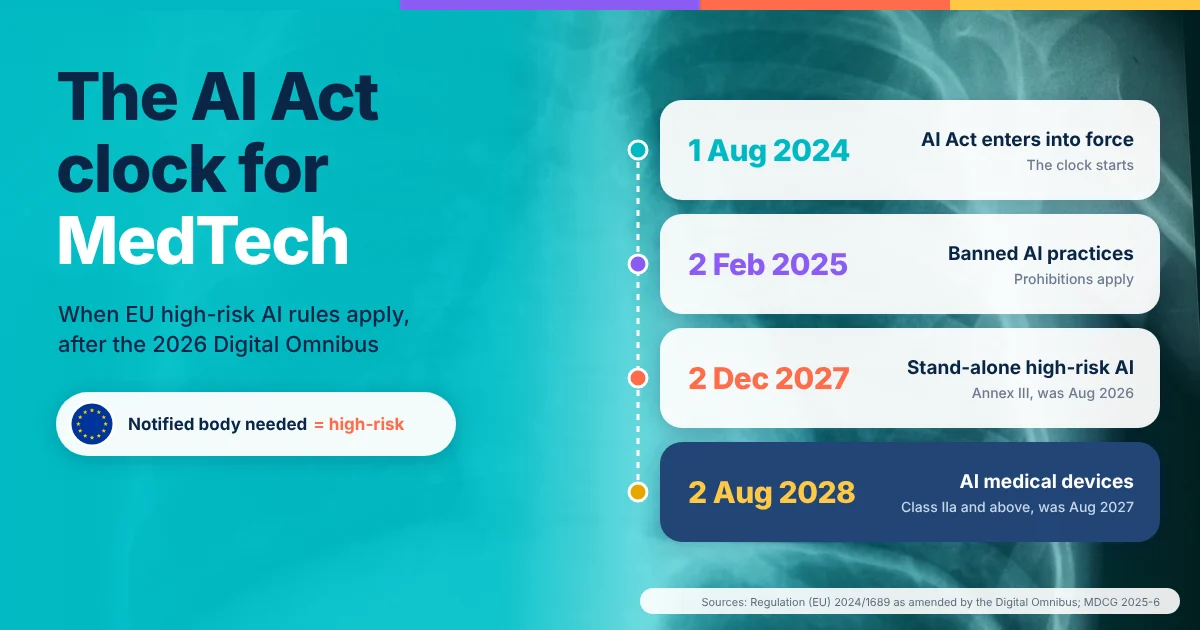
The original timetable would have applied high-risk rules to medical devices from 2 August 2027. EU institutions reached a political agreement on the Digital Omnibus on AI on 7 May 2026. The final text, Regulation (EU) 2026/1744 of 8 July 2026, was published in the Official Journal on 24 July 2026 and applies from 27 July 2026. The key dates now are:

  • Prohibited AI practices: 2 February 2025, unchanged.
  • General-purpose AI models: 2 August 2025, unchanged.
  • High-risk AI in Annex III (stand-alone uses): 2 December 2027, was 2 August 2026.
  • High-risk AI in regulated products, including medical devices (Annex I): 2 August 2028, was 2 August 2027.

Sources: Regulation (EU) 2026/1744, via Cuatrecasas (July 2026) and Gibson Dunn (May 2026).

The bigger fight was over scope. In December 2025, the Commission's proposal to simplify the MDR and IVDR (COM(2025) 1023) would have moved medical devices to Annex I Section B of the AI Act, where most high-risk requirements do not apply. Parliament and Council rejected that move in May 2026. As a compromise, the Commission can use implementing acts to limit specific AI Act requirements where the MDR or IVDR already give an equivalent level of protection (Gleiss Lutz).

Industry was not pleased. "This is not the outcome MedTech Europe sought," the trade association said, calling the MDR and IVDR revision "the critical vehicle" for avoiding duplicate requirements (MedTech Europe, May 2026).

What did we hear on our stage?

At MedTech Meets AI 2025 in Barcelona, Luca Neri, Vice President and Product Center Manager of Applied AI & GenAI at the Renal Research Institute, Fresenius Medical Care, summed up the relationship between the two laws in the regulation part of his presentation:

"AI Act & MDR: two uneven siblings."
Luca Neri, MedTech Meets AI, Barcelona, 2025

The MDR asks about safety, performance and clinical benefit. The AI Act adds data governance, logs, transparency and human oversight. Neri also pointed out that EU health technology assessment evidence requirements do not line up with either, so manufacturers can end up writing several dossiers for the same product.

He showed what that costs. A MedTech Europe survey he cited put CE-marking at 18 to 22 months, and found that the share of manufacturers choosing the EU as their first launch market fell by 40% for IVDs and 33% for medical devices. Yet his team's Anemia Control Model, a CE-marked neural network trained on more than 900,000 prescriptions, shows the payoff: published studies link it to 18% higher target achievement and fewer hospitalisations.

What does the AI Act add on top of the MDR?

According to MDCG 2025-6, the guidance on the interplay between the MDR, IVDR and AI Act published in June 2025, high-risk AI medical devices must also show:

  • Data governance: representative training, validation and test data, with bias examined.
  • Logging: automatic record-keeping of events over the system's life.
  • Transparency: clear instructions so users understand outputs and limits.
  • Human oversight: designed in as a risk-control measure.
  • Accuracy, robustness and cybersecurity: including AI-specific threats such as data poisoning and adversarial attacks.
  • Quality management: AI Act elements added to the existing MDR or IVDR quality system, not a second one.

The good news is that it runs through one process. The same notified body, if designated under both laws, assesses one technical file.

The tools for compliance are also arriving. In October 2026, EN 18286:2026, a quality management standard written for the AI Act, became the first harmonised standard referenced in the Official Journal, through Implementing Decision (EU) 2026/2274. Building an AI quality system on it gives a presumption of conformity with the AI Act's quality management article (CEN-CENELEC JTC 21).

What this means for MedTech teams

  • Classify your portfolio now. List every AI function, its MDR class and whether a notified body is involved.
  • Build one technical file. Map AI Act requirements onto your MDR documentation instead of starting a parallel file.
  • Fix data governance early. Training data quality and bias checks are hard to add after development.
  • Check your notified body. Confirm it plans to be designated under the AI Act as well, and map your quality system against EN 18286.
  • Follow Neri's playbook. In his words: "pick use cases with high-yield potential, validate locally, and account for CE-mark cost early in development."

What to watch in 2027

  • Commission implementing acts that limit AI Act requirements for medical devices where the MDR or IVDR already offer equivalent protection, and final guidelines on high-risk classification, published in draft in May 2026.
  • More harmonised standards after EN 18286, covering risk management, data governance, accuracy and robustness, which give manufacturers a presumption of conformity.
  • MDR and IVDR simplification: the December 2025 proposal is still going through Parliament and Council, and industry wants it to absorb AI Act requirements.
  • Notified body designations under the AI Act, and whether capacity keeps up.

Sources

  1. Neri, L. (2025). Clinical Applications of AI in Nephrology: Opportunities and Challenges. Presentation at MedTech Meets AI, UBIQ Events, Barcelona.
  2. Cuatrecasas. (2026). Digital Omnibus on AI has been published. cuatrecasas.com (accessed 23 October 2026)
  3. Gibson Dunn. (2026). EU AI Act Omnibus agreement: postponed high-risk deadlines and other key changes. gibsondunn.com (accessed 23 October 2026)
  4. Hogan Lovells. MDCG published new guidance on the interplay between the MDR, IVDR and the AI Act. hoganlovells.com (accessed 23 October 2026)
  5. Medical Device Coordination Group. (2025). MDCG 2025-6: FAQ on the interplay between the MDR, IVDR and the AI Act.
  6. Gleiss Lutz. (2025, updated May 2026). Radical simplification of the MDR and IVDR and broad inapplicability of the AI Act to medical devices and IVDs. gleisslutz.com (accessed 23 October 2026)
  7. MedTech Europe. (2026). AI Act deal lands: what it means for the medical technology sector? medtecheurope.org (accessed 23 October 2026)
  8. CEN-CENELEC JTC 21. (2026). EN 18286 becomes the first harmonised standard under the EU AI Act. jtc21.eu (accessed 23 October 2026)
  9. Mayer Brown. (2026). EU AI Act news: Digital Omnibus on AI, new guidance on risk classification, GPAI and transparency obligations. mayerbrown.com (accessed 23 October 2026)

Header photo: Umanoide on Unsplash.

Frequently asked questions

Does the EU AI Act apply to medical devices?

Yes. AI systems that are medical devices, or safety components of them, are high-risk under the AI Act when the device needs notified-body assessment under the MDR or IVDR. The high-risk requirements apply to these devices from 2 August 2028.

Is a Class I AI medical device high-risk under the AI Act?

Usually not. Most Class I devices are self-certified, so they fall outside the Article 6(1) route. Class I devices that are sterile, have a measuring function or are reusable surgical instruments need a notified body and are high-risk.

Will medical devices be taken out of the AI Act?

Not for now. The Commission proposed in December 2025 to move medical devices to a lighter part of the AI Act, but Parliament and Council rejected this in May 2026. The Commission can still limit specific requirements by implementing act where the MDR or IVDR give equivalent protection.

What is MDCG 2025-6?

It is guidance from the Medical Device Coordination Group, published in June 2025, explaining how the MDR, IVDR and AI Act work together. It recommends one technical file and one conformity assessment for high-risk AI medical devices.

Do AI medical devices need two CE marks?

No. One conformity assessment, normally by the same notified body, covers both the device regulation and the AI Act, and the device carries one CE mark.

Where can I discuss AI regulation with MedTech leaders?

MedTech Meets AI, organised by UBIQ Events in Barcelona, brings together leaders from top MedTech companies to discuss AI regulation, imaging and diagnostics, and clinical adoption.

Join the discussion in person

MedTech Meets AI

Visit the conference